


























residence period:
2 or 5 years
Five years under the standard rule; two years with a qualifying family tie
Choose a Jurisdiction
RULATAM Solutions
rulatam
Applicants can generally apply after five years of residence; some qualifying family ties reduce the period to two years. This guide explains the requirements, documents and route to a Chilean passport.
Citizenship and passport
Applicants can generally apply after five years of residence. People with certain qualifying family ties to a Chilean citizen may apply after two years. Both routes require valid permanent residence.
residence period:
Five years under the standard rule; two years with a qualifying family tie
issuing authorities:
Review by the immigration service and a Carta de Nacionalización issued by decree
dual citizenship:
Chile permits multiple citizenship and does not require applicants to renounce their first citizenship
United States:
Visa Waiver Program for tourism and qualifying business travel, but not employment
(updated September 2026)
As of September 2026, the standard Carta de Nacionalización remains available after five years of residence in Chile. The period runs from the Estampado Electrónico for the Residencia Temporal that led to the applicant’s current Residencia Definitiva, not from the date permanent residence was granted and not necessarily from the first temporary permit. A qualified naturalization route is available after two years of continuous residence to a Chilean citizen’s spouse, parents, children and other blood relatives up to the second degree, people adopted by Chileans, and certain children of former citizens. Reaching the required period does not itself confer citizenship: the applicant must hold valid permanent residence, be in Chile when filing online, and document income, background and the absence of disqualifying circumstances.
Congress is also considering stricter rules: a ten-year period of continuous permanent residence and an examination on Chilean culture and civics. This is a material policy risk for a long-term plan, but it is not current law. SERMIG’s present guidance retains the five-year rule. Naturalization remains a discretionary state decision issued by decree, rather than an automatic right acquired by completing the residence period.
Legal grounds, the consequences of naturalization and the passport’s practical value
Chile’s Constitution recognizes four grounds: birth in Chile, descent from a Chilean parent, a Carta de Nacionalización, and special naturalization granted by law. For an adult foreign national, the standard route is lawful temporary residence, valid permanent residence, completion of the required residence period and a separate application to SERMIG.
Chilean jus soli is not unconditional. It excludes children of foreign nationals serving their own governments and hijos de extranjeros transeúntes, or children of transient foreign nationals. If that notation is made, the parents may establish their intent to settle through a residence application, employment, a lease, utility bills, and medical or educational ties. The first step is a Pronunciamiento de Nacionalidad. An adverse decision may be challenged administratively before proceeding to court. In practice, a dispute may take 6–12 months, although timing and outcome depend on the evidence.
The standard residence period is five years. SERMIG counts it from the Estampado Electrónico for the Residencia Temporal that led to the applicant’s current Residencia Definitiva, rather than from a tourist entry or the date permanent residence was granted. If the subcategory or sequence of statuses changed, the period cannot safely be described as running from the first temporary permit without reviewing the file. Permanent residence must remain valid on the filing date; the authority also reviews the travel certificate and immigration history.
Nacionalización Calificada is available after two years of continuous residence to a citizen’s spouse, father or mother, children and other blood relatives up to the second degree, people adopted by Chileans, and certain children of former citizens. As of September 29, 2026, the proposed ten years of permanent residence and an examination on Chilean history and government remain part of a bill, not a current requirement.
There is no published fixed limit on travel for a Carta application. SERMIG considers the length and frequency of absences, housing, family, employment or business, taxes and the reasons for travel. Local practitioners report that an absence of more than three months during the PDI review may raise questions about whether the applicant still intends to live in Chile, but this is a practical benchmark, not a statutory ground for automatic refusal. Actual applications filed without objections in September 2021 and May 2023 resulted in decrees only in June and August 2026; the first case required a recurso de protección over the delay.
Citizenship secures an unconditional right to live in Chile and return to the country, obtain Chilean documents and receive consular protection. Adult citizens may vote in elections and referendums unless their political rights have been suspended on constitutional grounds.
Naturalized citizens receive most rights on the same basis as citizens by birth, but do not immediately become eligible for elected public office. Article 14 of the Constitution imposes a five-year waiting period after the Carta de Nacionalización is granted. Some senior offices carry additional constitutional requirements concerning citizenship by origin.
A Carta is a discretionary state grant, not an automatic right. After the online filing, SERMIG reviews the documents, obtains a police report and PDI interview, and may request additional information. A home visit or direct call to an employer is not typical, but employment status, contributions, taxes and immigration movements are reviewed through documents.
The evidence depends on the applicant’s circumstances. An employee provides a contract, pay slips, AFP records and health contributions; a self-employed person provides the start-of-activities filing and tax folder; a business owner provides company records, tax returns and evidence of profit distributions; a person living on passive income provides leases or financial assets and account activity; a retiree provides pension payments. There is no general formal minimum income, and dollar-based benchmarks are only practical estimates of whether a household has sufficient means.
For a financially dependent applicant, the local partner recommends preparing proof of the family relationship, a declaration of support and evidence that the supporting person has sufficient means. The appropriate category and evidence depend on the family’s circumstances.
Local specialists report that objections and refusals may result from expired or inconsistent documents, serious immigration violations, failure to attend an interview, tax issues or insufficient evidence of lasting ties to Chile. The reason must be assessed from the specific decision; completing the residence period and holding permanent residence do not by themselves guarantee approval.
Chile does not use the U.S. model of citizenship-based taxation. A Chilean passport does not by itself create an obligation to report worldwide income; domicilio and residencia tributaria are controlling. A citizen who lives permanently abroad without Chilean tax domicile or residence does not become a Chilean tax resident solely because of citizenship.
Tax residence generally arises after 184 days in Chile, whether consecutive or in total, during any rolling 12-month period. Tax domicilio may arise earlier from a combination of residence and intent to remain. A foreign national who first establishes domicile or residence in Chile generally pays tax only on Chilean-source income for the first three years, and then on worldwide income. A Carta de Nacionalización neither resets nor restarts that period: immigration, citizenship and tax histories are calculated separately.
SERMIG expressly confirms that Chile permits multiple citizenship. A Carta de Nacionalización does not require renunciation of an existing citizenship, and later acquiring another citizenship does not by itself terminate Chilean citizenship. A voluntary renunciation of Chilean citizenship is effective only if the person already holds another nationality.
Restrictions may come from the other country, which may decline to recognize multiple citizenship, require notification or treat the person solely as its own citizen within its territory. After the decree, the applicant obtains a new cédula and, if needed, a passport from the Registro Civil. Local practice indicates an average of about three months for the documents and roughly two additional months for a separate naturalized-citizen certificate. These are practical estimates, not guaranteed processing times.
Article 11 of the Constitution allows citizenship to be lost through voluntary renunciation, a decree for serving an enemy during an external war, revocation of a Carta de Nacionalización, or a law withdrawing citizenship granted by special grace. For a naturalized citizen, the principal risk is executive revocation of the Carta.
Under Article 8 of Decreto Supremo 5.142, revocation is possible if the Carta was granted unlawfully, if circumstances make its holder “unworthy” of the benefit, or if the holder is convicted of crimes against state security. Revocation requires a Council of Ministers decision and a reasoned presidential decree. An appeal to the Corte Suprema must be filed within 30 days and stays the decision.
A Chilean citizen does not lose citizenship by living abroad for an extended period, allowing a passport to expire or acquiring another citizenship. Renunciation must be voluntary and requires another nationality, protecting the person from statelessness. For citizens by birth, an administrative authority cannot simply cancel citizenship as it might cancel an immigration permit.
A Carta de Nacionalización has less protection than citizenship by birth because the Constitution expressly provides for its revocation. For a naturalized citizen, the accurate description is a status that continues indefinitely unless one of the narrow constitutional grounds for loss is invoked.
Chile participates in the U.S. Visa Waiver Program. The holder of an electronic passport and an approved ESTA may visit the United States for up to 90 days for tourism or qualifying business travel. ESTA does not authorize employment or permanent residence and does not guarantee admission; CBP makes the final decision.
Chileans do not need a standard visa for short visits to the Schengen Area and may enter Argentina, Bolivia, Brazil, Colombia, Ecuador, Paraguay, Peru and Uruguay with a valid cédula. This combination of regional mobility and Visa Waiver access is one of the passport’s principal practical benefits.
Marriage or family ties do not confer citizenship automatically, but may reduce the residence period from five years to two. For a spouse, the marriage must be registered in Chile, have existed for at least two years and involve a shared family life under Article 133 of the Código Civil. The two-year marriage period runs from the date of the marriage, not from a later registration in Chile; a certificate alone is insufficient without evidence of the family relationship.
The qualified route also covers the father or mother of a Chilean child, other blood relatives of Chileans up to the second degree, adopted people, and a child whose parent lost Chilean citizenship before the child’s birth. Every route requires valid permanent residence, continuous residence and a separate Carta. The birth of a child in Chile does not automatically give the parents a passport.
Filing from abroad, Residencia Temporal grounds, timelines to permanent residence and support fees.
RUT, property due diligence and the transaction process for a foreign buyer.
Cities, cost of living, taxes, business advantages and the country’s legal profile.
Compare timelines and routes in Argentina, Brazil, Uruguay, Paraguay, Panama, Costa Rica and Chile.
Current design: ordinary cover, data page and visa pages featuring Chile’s regions
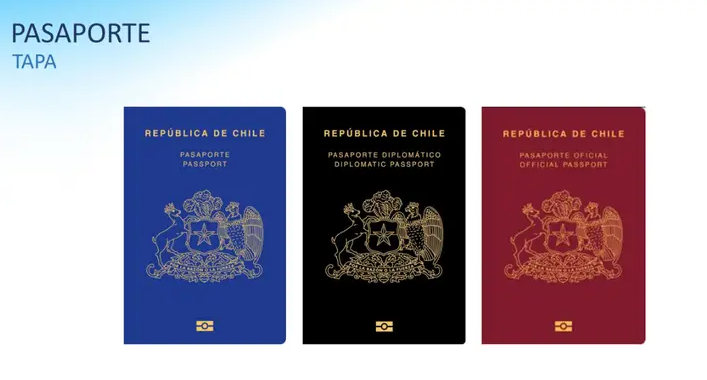
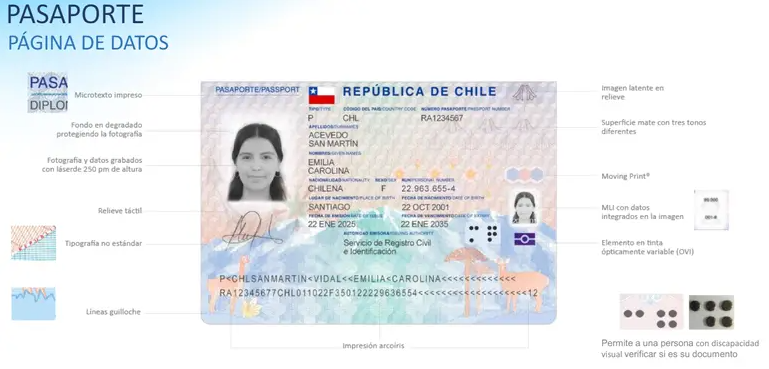

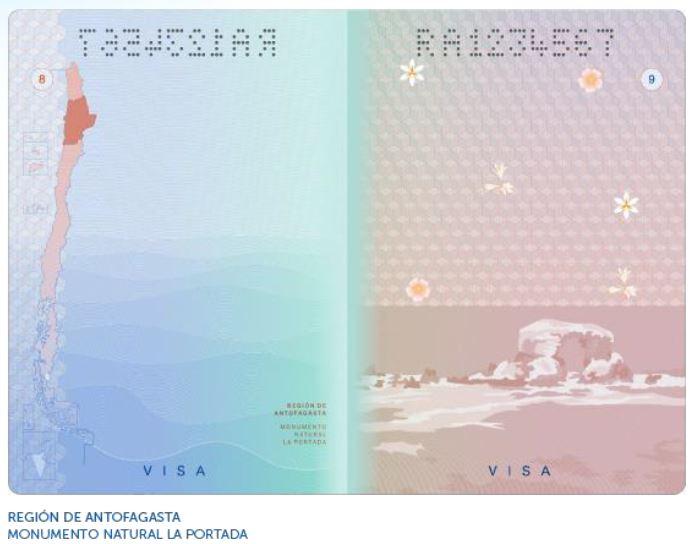
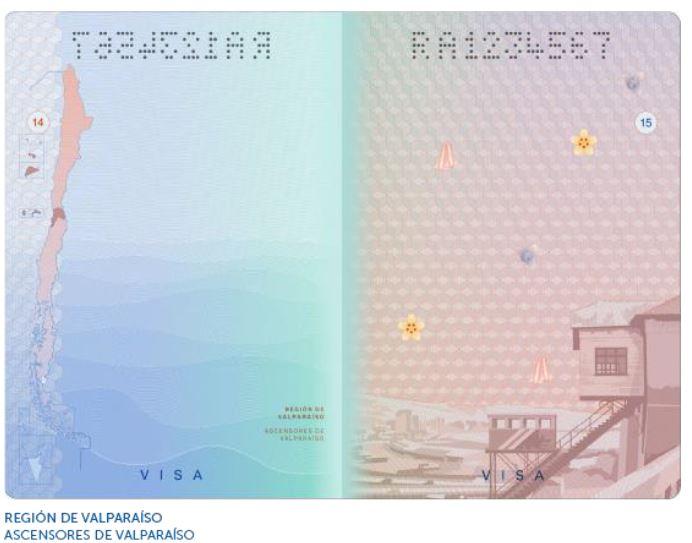
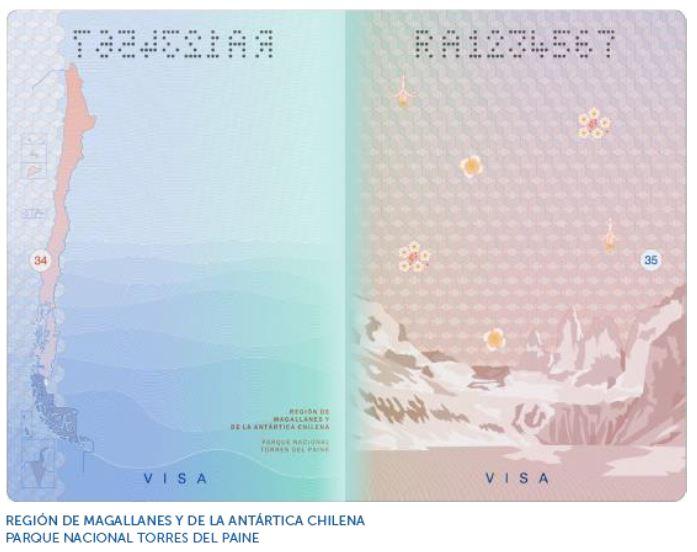
The sample data page and blank visa pages are demonstration materials from the Registro Civil de Chile, published by T13 and El Dínamo when the document was unveiled. The data page contains demonstration data, not client information.
Concise answers on timelines, family-based routes, dual citizenship and the risks of a Carta de Nacionalización
The standard rule is five years from the Estampado Electrónico for the Residencia Temporal that led to the current Residencia Definitiva. This is not always the person’s first temporary permit. A two-year route applies to a citizen’s spouse and certain other qualifying family ties. There is no requirement to wait another five years after permanent residence is granted.
No. The application is completed through an online portal, but SERMIG permits filing only from Chile. On the filing date, the applicant must be in the country and hold valid Residencia Definitiva; ClaveÚnica alone does not allow an application from abroad.
Marriage only shortens the residence requirement. It must be registered in Chile, have existed for at least two years and involve a shared family life. The applicant still needs valid permanent residence, two years of continuous residence and a favorable decision in a separate Carta proceeding.
Not always. A child may be registered as a hijo de extranjero transeúnte if the parents had no intention of settling in Chile. That classification may be challenged through a Pronunciamiento de Nacionalidad. If the notation remains, the child may elect Chilean citizenship within one year after turning 18.
No. Chile permits multiple citizenship and does not require renunciation when granting a Carta de Nacionalización. Whether the applicant can retain the first citizenship must be checked under that country’s law, which may not recognize dual citizenship or may require notification.
No. Taxes depend on domicilio and residencia tributaria, not citizenship. Naturalization does not automatically begin tax residence or reset the three-year period during which a newly settled foreign national generally pays tax only on Chilean-source income.
Yes, on grounds stated in Decreto Supremo 5.142, including an unlawful grant or a conviction for crimes against state security. Revocation requires a Council of Ministers decision and a presidential decree. An appeal to the Corte Suprema must be filed within 30 days and stays the revocation.
No. As of September 29, 2026, SERMIG applies the current periods: five years under the standard route and two years for Nacionalización Calificada. The ten-year period and an examination on culture and civics remain part of a bill; transitional rules will appear only in the final law.