


























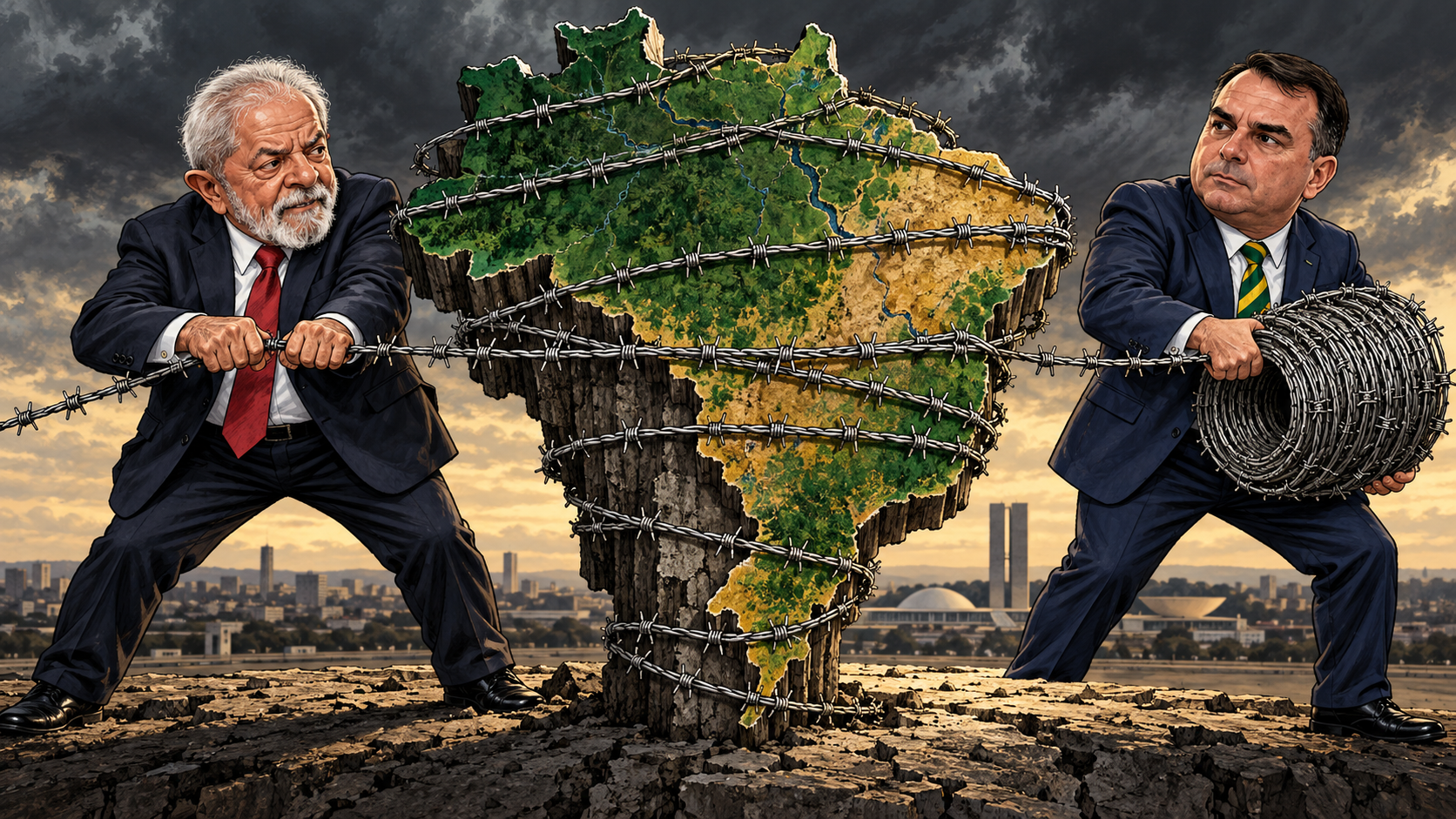
Brazil cancels visa-free entry for your passport. Residence permits already issued to foreigners are revoked. Children born to foreign parents in Rio or Florianópolis no longer leave the maternity ward as Brazilian citizens.
This is the nightmare facing immigrants before Brazil votes on October 4. The winner will control a country that still offers one of the world’s most generous combinations of birthright citizenship, family residency and accelerated naturalization. Four years is more than enough time to make that route harder.
The Obvious Choice
President Luiz Inácio Lula da Silva enters the final week before the election with 40%. Flávio Bolsonaro, the eldest son and political heir of Jair Bolsonaro, has 36%. In a runoff, Datafolha puts them almost level: 47% against 45%.
Their political identities appear to settle the immigration question before it has even been asked. Lula speaks about human rights, integration and protection. Bolsonaro promises security, closer relations with conservative governments and a state less embarrassed about saying no.
For anyone planning a move to Brazil, Lula looks like the safer name on the ballot. His record makes that choice considerably less comfortable.
A Queue That Changed the Answer
Appointments with the Federal Police used to take days in many Brazilian cities. They can now take one to three months, followed by further delays in registration, RNM processing and the production of the plastic CRNM residence card.
Lula’s government approved a National Policy on Migration, Refuge and Statelessness. The reform gave ministries a cleaner administrative structure, but it did not make obtaining Brazilian residency faster. It did not reduce the number of documents, appointments or checks either.
Naturalization followed the same direction. Applicants must prove continuous residence with at least one document for every year under consideration. Brazilian citizenship remains available, but a missing lease, bank statement or utility bill can now leave a hole in a case that has taken years to prepare.
Visa policy offers an even clearer example. Lula reinstated visa requirements for citizens of the United States, Canada and Australia because those countries demand visas from Brazilians. The decision was presented as reciprocity, and it established something every foreign resident should remember: visa-free entry is a political decision, not a permanent entitlement.
The government went further at Guarulhos Airport in 2024, restricting access to asylum procedures for some passengers using Brazil as a transit point. The Federal Public Defender’s Office called the practice illegal, but the people stopped at the airport still had to rely on lawyers and courts.
Lula has kept Brazil open while allowing legal immigration to become slower and more suspicious of the people using it. Anyone waiting months for a Federal Police appointment may begin to remember the Bolsonaro years as a more efficient time. A bill moving through Congress makes that memory dangerous.
The Bill Without Bolsonaro’s Name
Its number is PL 2523/2019. In April 2026, it passed the Foreign Relations Committee of the Chamber of Deputies and continued its journey through Congress.
The proposal would count the residence period required for naturalization from the moment a foreigner receives permanent status. It would also require proof of lawful means of support, introduce an assessment of “good social conduct” and allow Brazilian authorities to examine criminal proceedings and convictions abroad.
Those words create practical powers. An official would be able to ask what level of income is sufficient, which documents prove good conduct and whether a foreign investigation without a conviction should damage an application. Each answer can produce another document request, another delay or a refusal of Brazilian citizenship by naturalization.
Flávio Bolsonaro did not write the bill. It was introduced by Luiz Philippe de Orléans e Bragança, who was elected in 2018 through Jair Bolsonaro’s party, and its rapporteur is General Girão of PL — the party now represented by Flávio.
The distinction matters because the candidate cannot honestly be called the author of PL 2523. Its political origin matters more: the people advancing stricter naturalization rules belong to the movement that wants to return to the presidency.
What a President Does Not Need Congress For
Brazil’s Constitution protects citizenship acquired by birth. The courts would immediately face any attempt to strip Brazilian children of that status or cancel valid residence permits on a mass scale. This is a mature republic whose presidents are constrained by Congress and the Supreme Federal Court.
The most effective pressure on immigrants requires no constitutional amendment. The president appoints the minister of justice, influences the leadership of the Federal Police and controls the administration that decides which documents are requested, how closely they are examined and how long applicants wait.
The executive also controls visa policy and decides whether to support, weaken or veto legislation passed by Congress. A president may fail to remove a legal right and still make exercising that right expensive, slow and uncertain.
Families considering having a baby in Brazil are especially exposed to this difference. The child’s citizenship rests on the Constitution, but the parents still need the state to register their residency, issue identity documents and process their future naturalization. Every one of those stages is administrative before it becomes constitutional.
October 5
A Lula victory would preserve the legal structure that attracts immigrants to Brazil. Birthright citizenship would remain untouched, parents of Brazilian children would retain their residence route, and the reduced naturalization period would survive. So would the queues, expanding document requirements and a government that has shown no interest in restoring the simplicity of the previous system.
A Flávio Bolsonaro victory would inherit the same bureaucracy and add political pressure for tougher rules. PL 2523 would gain a president with little reason to resist it, while the Ministry of Justice and the Federal Police would be expected to demonstrate that the new government was confronting abuses of immigration and citizenship.
Brazil offers immigrants no ally in this election. Lula has made the existing route slower and harder without trying to close it. Bolsonaro’s political camp is preparing to make that route narrower in law.
Lula is the disappointment. Bolsonaro is the danger. If your family is already building a life around Brazil, the practical advantage belongs to those who enter the system and document their status before the rules become a campaign trophy. RULATAM can review that strategy in a private consultation.