


























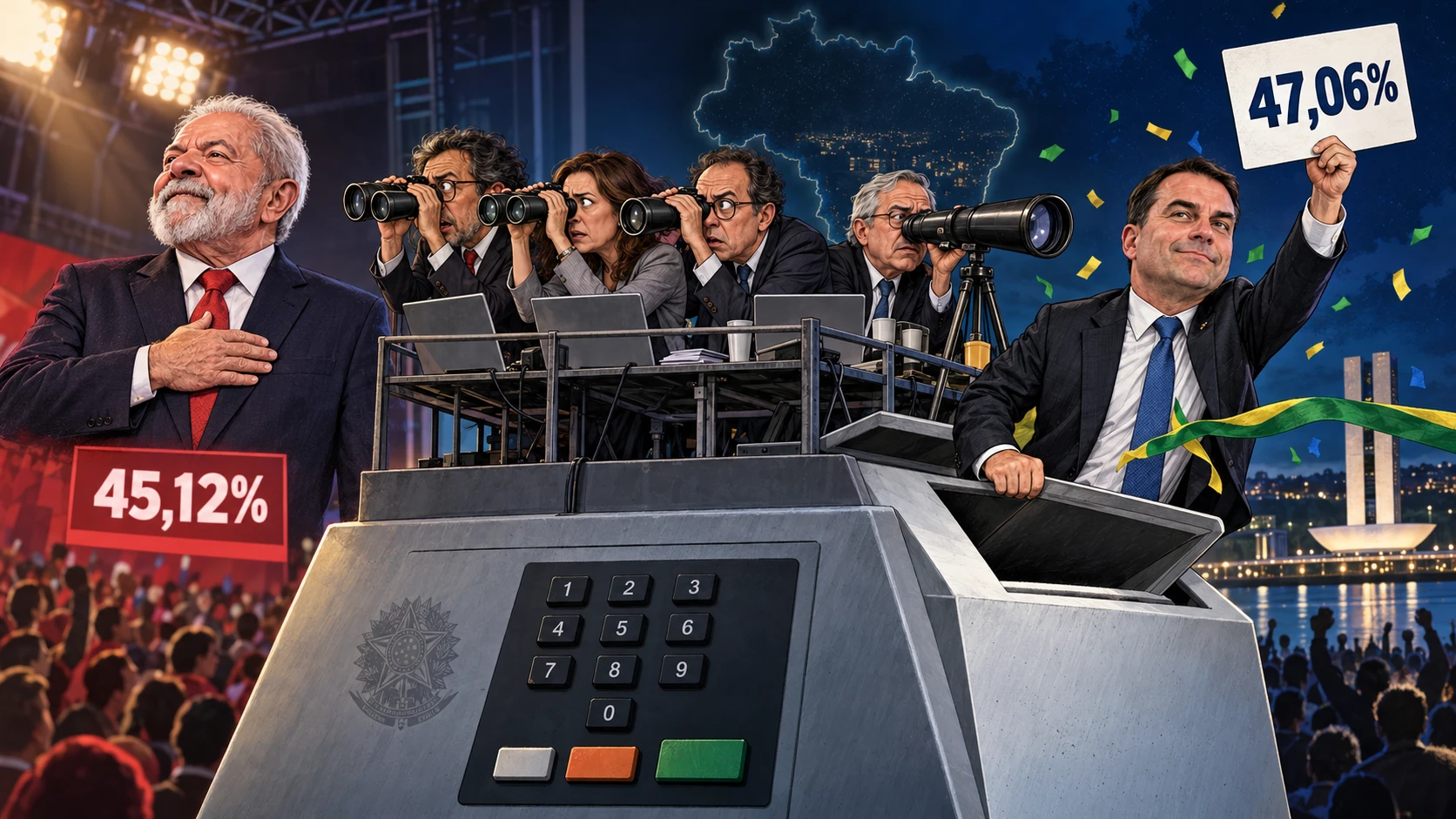
Most major pollsters put Lula first. Brazil put Flávio Bolsonaro first instead. The former president’s eldest son won 47.06% of the valid vote, against 45.12% for the incumbent, a lead of roughly 2.3 million votes. Neither crossed 50%, so Brazil will vote again on October 25.
A runoff had been expected for months. Lula finishing second had not. His campaign presented the government as economically successful, while much of the political establishment still treated Flávio as an extension of his father rather than a likely winner.
How Wrong Were Brazil’s 2026 Election Polls?
The final Datafolha poll put Lula on 45% and Flávio on 40% among valid votes; a later election-eve update narrowed that gap but still kept Lula ahead. CNT/MDA reported 47.8% to 42.1%, while Quaest had 46% to 45%. The large pollsters saw a close election, but most of them named the wrong leader.
Lula’s result was not wildly different from the forecasts. Flávio’s support was the part they missed. An average of several polls did not solve the problem because most of them were wrong in the same direction.
Four of the final eleven published polls did put Flávio first. Palver gave him 47%, Gerp 46%, Vox Brasil 45.8% and Veritá 45.14%. Palver came closest to his final share, while Gerp was among the better estimates of the gap. Those firms deserve more attention in the runoff, but one accurate result does not make any pollster permanently reliable.
A missed forecast is not evidence that pollsters were bought. It means their samples or turnout assumptions failed to capture part of Flávio’s vote. We still do not know whether that support was already being missed during fieldwork or moved only in the final days.
Where Did Lula’s Votes Go?
More than 33 million Brazilians did not vote. Abstention reached 21.1%, the highest first-round rate in a presidential election, and Lula received about 3.5 million fewer votes than he did in the first round of 2022. That makes low mobilisation the obvious first explanation.
Some Lula supporters may have believed the polls and treated the first round as optional. But that remains a hypothesis until precinct-level results are compared with income, region and past turnout. Another explanation is less comfortable for the government: people can approve of individual programmes and still feel that food prices, household debt or public safety have not improved enough.
Flávio had the opposite advantage. Voters who wanted to prevent another Workers’ Party term had one obvious place to go, and the Bolsonaro name gave them a ready-made vehicle. A late consolidation on the right would be easy to undercount if it occurred after much of a poll’s fieldwork was complete.
Who Is Favoured in the October 25 Runoff?
The eliminated candidates received 7.82% between them. If turnout stays unchanged, Flávio needs a little more than one third of those votes to pass 50%; Lula needs almost two thirds. A pre-election transfer poll found that 43% of other candidates’ supporters preferred Flávio in a runoff and 30% preferred Lula, with the rest undecided, abstaining or planning a blank vote.
That arithmetic makes Flávio the favourite, not the president-elect. Lula’s second route is to bring back voters who stayed home. In 2022, Lula added about 3.1 million votes between rounds, while Jair Bolsonaro added about 7.1 million. Both camps know how to mobilise, and the right has previously found the larger reserve.
History also leans toward the first-round leader. In every Brazilian presidential election decided by a runoff since 1989, the candidate who led the first round went on to win. Lula now has three weeks to break that record, and he has to do it after losing the advantage that was supposed to make his campaign look inevitable.
Is Brazil Part of a Latin American Political Pendulum?
Brazil’s result fits a regional habit: voters replace the left with the right, then punish the right and turn back again. Argentina and Chile have already changed direction. This is not one coordinated conservative wave; it is a collection of national electorates blaming the government they can actually remove.
Brazil is Latin America’s largest economy and most populous country, so its choices affect regional diplomacy, trade and the arguments used in elections elsewhere. This time it is also following a regional pattern: incumbency has become a burden, even when a government can point to favourable national indicators.
What Would Either Result Mean for Immigration?
Lula preserved Brazil’s broadly open legal framework, but legal immigration did not become easier under his government. In RULATAM’s recent cases, Federal Police appointments in major cities have taken one to three months, with further delays affecting residence registration and RNM cards. The rules remain attractive; the offices applying them are slow.
The Bolsonaro camp presents itself as the law-and-order alternative, while its allies have promoted a bill that would make naturalisation harder. A president cannot abolish birthright citizenship or cancel every valid residence permit by decree: Congress, the Constitution and the Supreme Federal Court constrain him. He can still influence visa policy, the Ministry of Justice, Federal Police priorities and the administrative treatment of immigration cases.
Our earlier analysis of Lula and Bolsonaro’s immigration records explains that difference in detail. For an international applicant, Lula means a higher chance of keeping the current rules together with the same slow bureaucracy. Flávio means a greater risk of new restrictions affecting Brazilian residence and the route to a Brazilian passport.
Flávio now needs to keep most of the voters who came out for him on October 4. Lula needs both a better share of the eliminated candidates’ vote and higher turnout among his own supporters. Anyone planning a move to Brazil or having a child in Brazil should now check the timing of that plan against both outcomes, not against the old assumption that Lula would finish first. RULATAM can do that in a private immigration consultation.