

























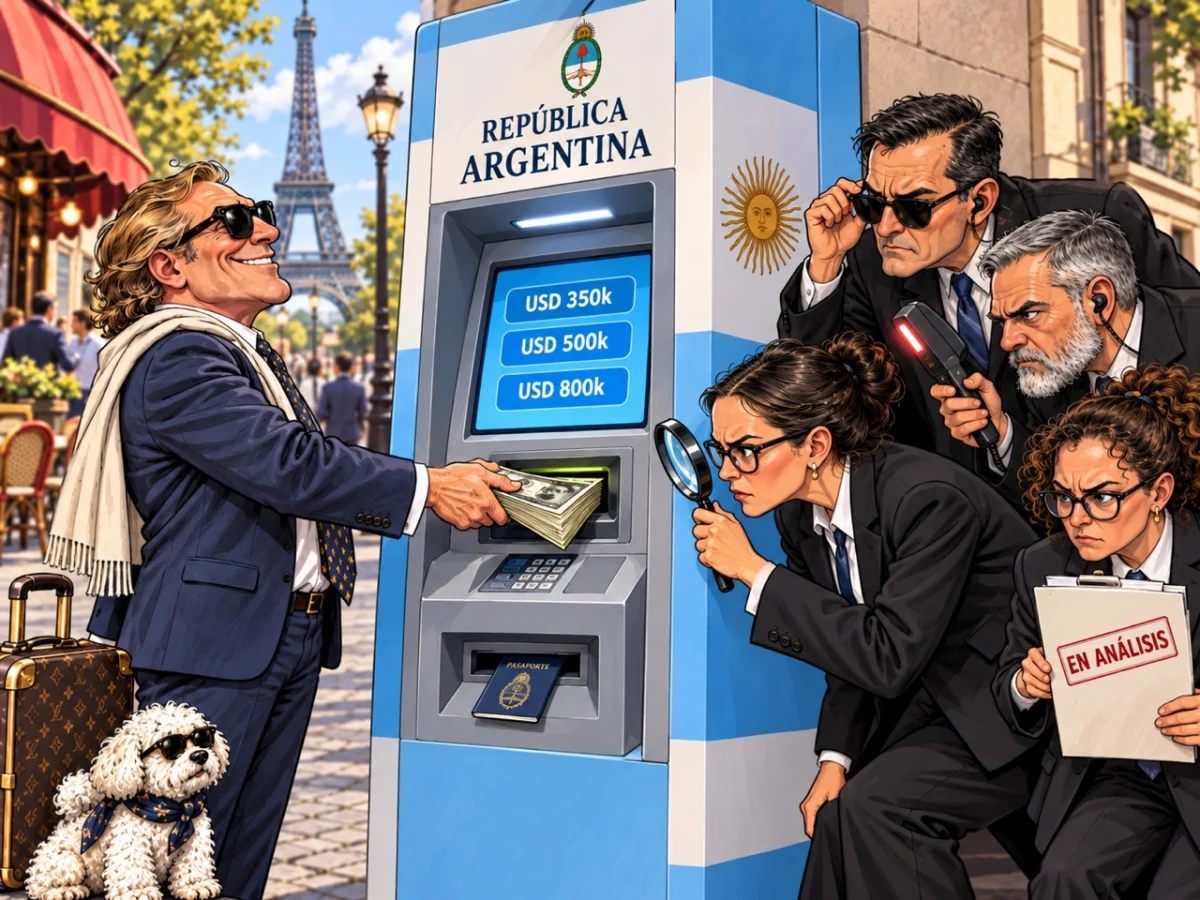
Argentina has put a price on a passport it is not yet certain it can issue this way. The headline number is $350,000 for one applicant. A family of two adults and two children would pay $500,000. Applications, the government says, should open before the end of 2026.
The numbers are unusually precise for a programme that still lacks its final rulebook. They are also only half the story. Argentina has explained how much it wants investors to pay. It has not yet explained exactly when they must pay, what protects the money if an application fails, or how the programme survives a court ruling against the decree beneath it.
The Paris Price List
Economy Minister Luis Caputo and Chief of Cabinet Diego Santilli presented the programme on October 2 during Argentina Week in Paris. President Javier Milei attended the week with a large government delegation. The official announcement says applications will be accepted during the fourth quarter of 2026.
Until Paris, the government had supplied a legal mechanism without a price. DNU 366/2025 amended Citizenship Law No. 346 so that a foreigner making a “relevant investment” could seek citizenship regardless of time spent living in Argentina. Decree 524/2025 then created the procedure around the new Citizenship by Investment Programs Agency. Neither answered the question that mattered most to an investor: how much?
Two Ways to Pay
The first route is a direct $350,000 contribution to Argentina’s Treasury. It is non-refundable. Once paid under the programme, the money belongs to the state.
The second route requires $800,000 in a special sovereign bond to be issued for the programme. That may sound less expensive because the principal is meant to remain an asset, but the government has not published the bond’s maturity, transfer restrictions, repayment mechanics or full financial terms. Until those details appear, nobody can calculate the real cost of locking up $800,000.
This is not a cosmetic difference. One applicant may prefer to lose $350,000 and retain control of the rest of the capital. Another may prefer to place a larger sum with the state and recover it later. Today, only the first calculation is complete.
The Family Arithmetic
A spouse adds $100,000. An unmarried child aged 18 to 25 with no children of their own also adds $100,000. Each child under 18 adds $25,000.
That produces the government’s example: $350,000 for the main applicant, $100,000 for a spouse and $25,000 for each of two minor children — $500,000 in total. Every payment must move through the formal financial system.
The announcement does not yet explain every family problem that tends to appear in real files: children who turn 18 during processing, dependants from a previous marriage, custody documents, adopted children or a family member who fails due diligence while the main applicant passes. Those details affect both the price and whether a relative can be included at all.
The Applicant Behind the Money
Argentina is not proposing an automatic passport purchase. The Citizenship by Investment Programs Agency will examine identity, source and movement of funds, assets, criminal history, reputation, immigration history and risks connected to the applicant’s jurisdiction.
The review may involve the intelligence service SIDE, the Financial Intelligence Unit UIF, the Ministry of Security, the Ministry of the Interior, the national criminal-record and identity registries, and any other public or private body the agency considers necessary. The government says the process will follow OECD and FATF standards on financial transparency, money laundering and terrorist financing.
After the agency completes that work, it sends a recommendation to the National Directorate of Migration. Decree 524 gives Migration 30 business days to approve or reject the file after receiving the report. That is not a 30-day processing promise: the decree places no published deadline on the investigation that comes first.
For a serious applicant, the source-of-funds file may therefore matter as much as the investment itself. A person who can transfer $350,000 but cannot reconstruct how the capital was earned, taxed and moved may have the price and still lack the application.
The Missing Pages
No final application form, document list or opening date has been published. The government has not said whether applicants will receive approval before transferring the contribution, whether money will be held in escrow, what happens after a refusal or how an administrative appeal will work.
The bond route has an even larger blank space. Its issue documents do not yet exist publicly. There is no disclosed maturity date and no complete answer on repayment. Nor is it clear how long the full security review will take in an uncomplicated case.
That distinction matters for anyone comparing the announcement with established citizenship-by-investment programmes. Argentina has announced a price and an intended launch window. It has not yet opened a product that an adviser can responsibly submit.
The Decree in the Room
The programme rests on DNU 366/2025. In July 2026, however, the National Electoral Chamber ruled in a specific citizenship case that electoral courts — not Migration — retained authority over naturalisation and declared the decree void. The judges said the executive had exceeded its constitutional authority by permanently changing the citizenship system through an emergency decree.
The government is nevertheless building an administrative programme in which Migration makes the final decision. That collision is no longer an academic debate. It raises practical questions about who can grant the citizenship, whether a successful applicant may later face litigation and what happens to invested funds if the procedure is stopped by a court.
RULATAM is reviewing those questions with Argentine lawyers. The legal effect of the judgment on the investment programme deserves a separate analysis; compressing it into a reassuring sentence here would be less useful than admitting that the answer is still contested.
What $350,000 Buys Today
Today, it buys no passport and no place in an application queue. It is the announced entry price for a programme the government expects to open during the fourth quarter of 2026. Before anyone transfers money, Argentina still needs to publish the operational rules, the bond terms and a defensible answer to the court problem.
That does not make Argentina irrelevant. The country already has residence and naturalisation routes that do not require a $350,000 contribution. Our English guide to moving to Argentina explains the wider immigration system, while the page on Argentine citizenship and passports covers the routes that exist independently of the new announcement.
The investment programme may become attractive once the missing documents exist. Until then, the rational choice is to compare it with routes that can be used now and to separate a government launch announcement from an application-ready legal product. RULATAM can review that decision in a private immigration consultation.